








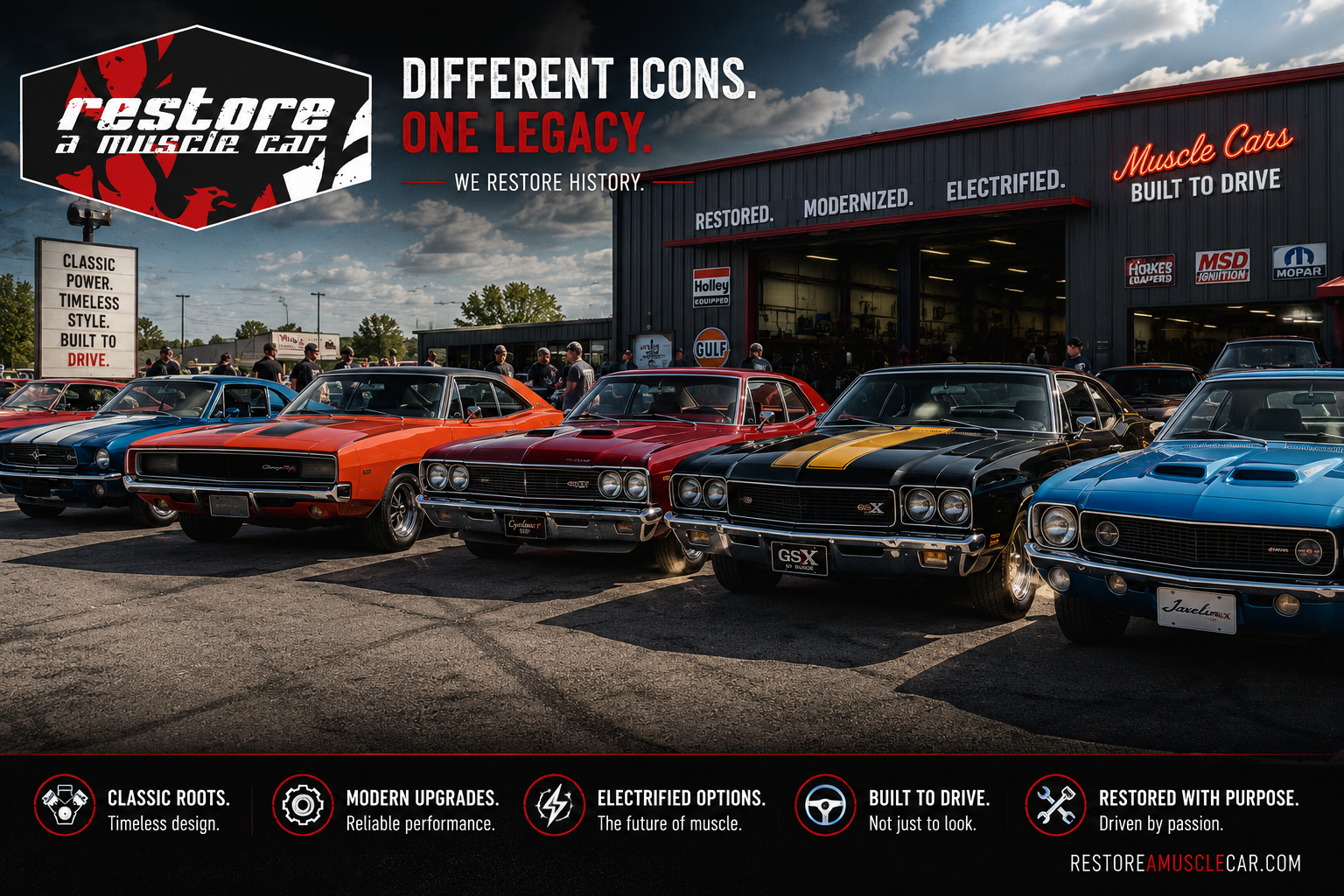
Introduction: Not Every Classic Has to Be a Camaro
Let’s face it — when people think “muscle car,” they picture a 1969 Camaro SS, a Dodge Charger R/T, or a Mustang Fastback burning rubber across the screen. And for good reason: these icons shaped a generation. But beneath that spotlight lies a whole other world of vintage muscle, waiting to be rediscovered.
At Restore a Muscle Car, we’ve had the pleasure of working on both the legendary and the overlooked. And we can tell you — some of the most rewarding restorations we’ve done weren’t the big-name builds. They were the hidden gems. The underrated muscle cars that surprise even the seasoned show-goers and are rapidly rising in both collector value and enthusiast love.
Whether you’re a first-time buyer looking for a more affordable entry point or a collector ready to stand out at the next show, this post is your map to muscle car treasure that’s still within reach.
What Makes a Muscle Car “Underrated”?
To us, an underrated muscle car is one that checks all the boxes — performance, styling, historical significance — but doesn’t get the mainstream recognition it deserves.
These cars often:
Were produced in limited numbers
Shared drivetrains with more famous models
Had unique styling or branding quirks
Lived in the shadows of their better-known siblings
The best part? They’re typically more affordable to buy and insure, offer similar or identical powerplants, and are rising fast in value as collectors search for the next big thing.
Five Underrated Muscle Cars We’d Restore in a Heartbeat
1. AMC Javelin AMX (1968–1974)
A bold blend of pony car styling and track-ready aggression, the Javelin AMX was AMC’s answer to the Mustang and Camaro — and it hit harder than most people remember.
Why it’s great: Available 390 and 401 cubic-inch V8s, race-winning Trans-Am pedigree, and wild color options like Big Bad Orange.
What to watch for: Rust-prone rear quarters and scarce trim, but otherwise solid.
Cool factor: Few cars draw as much conversation at shows — especially with period-correct rally wheels and side stripes.
2. Mercury Cyclone GT / Spoiler (1966–1971)
A cousin to the Ford Torino but with more edge, the Cyclone GT came with performance options like a 428 Cobra Jet and 429 Super Cobra Jet — enough to humble any Chevelle.
Why it’s great: NASCAR lineage, cool graphics packages, Ram Air options.
What to watch for: Trim pieces can be hard to find, but aftermarket support is improving.
Cool factor: The Dan Gurney and Cale Yarborough Spoilers are vintage racing royalty.
3. Buick GSX (1970–1972)
Sure, Buick built comfortable cruisers — but in the early ‘70s, they also built a beast. The GSX was one of the fastest factory muscle cars of its day.
Why it’s great: Stage 1 455 V8, 510 lb-ft of torque, factory Hurst shifter, and outrageous color combos like Saturn Yellow.
What to watch for: They’re rare (only ~800 GSXs built in 1970), but values are still below Hemi Mopars.
Cool factor: It looks refined… until it blows the doors off the guy next to you.
4. Pontiac Ventura (1971–1977)
Often called the “budget GTO,” the Ventura was a compact muscle car that shared much of its DNA with the Nova but had distinct Pontiac flair.
Why it’s great: 350 and 400 V8s available, lightweight chassis, tons of GM aftermarket support.
What to watch for: Many were optioned conservatively — finding performance trims takes effort.
Cool factor: GTO-style split grille + Nova handling = sleeper fun.
5. Plymouth Duster 340 (1970–1973)
The Duster wasn’t marketed as a full muscle car, but the 340 package proved it belonged in the conversation — especially with its featherweight size.
Why it’s great: Light, quick, affordable, and built for fun.
What to watch for: Lower trim models were plentiful, but 340 cars with original motors are the true find.
Cool factor: They look mean with rally wheels and hood scoops — and leave people wondering how you pulled so far ahead.
Why Choose an Underrated Platform?
Beyond uniqueness, choosing a sleeper car comes with some serious perks:
💸 Lower Initial Cost
You’ll likely spend less on the purchase price — sometimes tens of thousands less than a mainstream equivalent.
🧰 Parts Sharing
Many of these cars share engines, brakes, or suspensions with other GM, Ford, or Mopar lines, making parts sourcing easier than you’d think.
🚘 Build Creativity
There’s more freedom with originality. Judges and internet forums won’t nitpick your spoiler bolts when you’re building something underappreciated.
🏆 Show Standout
At any meet, your build is guaranteed to turn heads — not because it's flashy, but because it's different.
📞Call to Action: Ready to Build a Classic That Stands Out?
You don’t have to follow the crowd. If you’ve found (or want help finding) a rare or underappreciated muscle car to restore, Restore a Muscle Car is here to help — from inspections to full restorations to sourcing the right parts.
📩 Contact Us and let’s build something memorable — something that turns heads not just for what it is, but because no one else has it.